Also like…. No decor, no desktop backgrounds, no city statues/sculptures, no designs on linens or curtains (shower kind or window kind), no clothes, no signs, no fonts, no apps, no packaged food or drink, no buildings, no….
People don’t realize all the subtle ways that there is art in their lives. Even if the original design or artist or whatever has past or whatever, it still had to be done by an artist in the first place.
There’s a reason art is the first signs of intelligence that anthropologists look at.
Also ignoring the fact that even people who go into something “useful” can experience a bad job environment
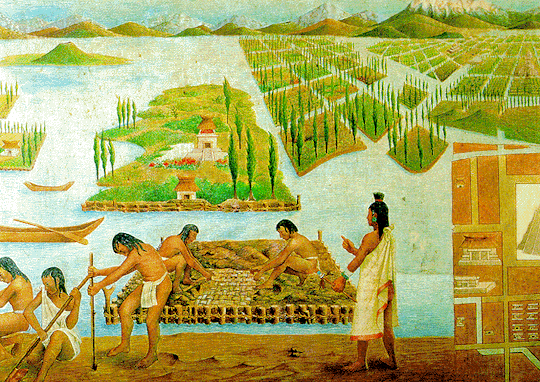
How on earth would you feed a city of over 200,000 people when the land around you was a swampy lake? Seems like an impossible task, but the Aztec managed it by creating floating gardens known as chinampas, then they farmed them intensively.
These ingenious creations were built up from the lake bed by piling layers of mud, decaying vegetation and reeds. This was a great way of recycling waste from the capital city Tenochtitlan. Each garden was framed and held together by wooden poles bound by reeds and then anchored to the lake floor with finely pruned willow trees. The Aztecs also dredged mud from the base of the canals which both kept the waterways clear and rejuvenate the nutrient levels in the gardens.
A variety of crops were grown, most commonly maize or corn, beans, chillies, squash, tomatoes, edible greens such as quelite and amaranth. Colourful flowers were also grown, essential produce for religious festivals and ceremonies. Each plot was systematically planned, the effective use of seedbeds allowed continuous planting and harvesting of crops.
Between each garden was a canal which enabled canoe transport. Fish and birds populated the water and were an additional source of food. [x]
This is literally so cool. Not only does it contribute to spacial efficiency, but the canals would easily keep pests, weeds, and possibly even diseases out of the respective plots. Companion planting and bio-intensive planting would be so much easier. Water-wise systems would be inherently present. Plus it looks so super neat aesthetically. I am just all about this.
Indigenous civilizations invented sustainable development way before there was a term for it.
How much longer until the utopic Solarpunk future where Capitalism is dead and we all live in ecologically sustainable high-tech forest cities? Asking for a friend.
Until we make those ecologically sustainable high-tech forest cities ourselves. It’s going to take a lot of us to do it though, so best to spread the word (and gather native tree seeds).
And, like, get started now. Then our “weirdo houses” will be the only thing functioning when everything falls apart!
The only reason why we don’t live in a solarpunk world right now is because no one has bothered to make it yet.
We’ll have to make it ourselves, and we’ll have to help each other make it. That’s why it is solarpunk.
Some resources to consider creating or joining or doing:
Repair cafes – create or join your local repair cafe! Repair stuff, learn how to repair stuff, teach others how to repair stuff.
Map of Makerspaces – make some things! learn how to make some things! teach others how to make some things!
Community Garden Map (note that this is US-only, and not a complete list) – join a local community garden
Learn some basics on passive solar design – clever use of the sun can create extremely energy efficient homes and buildings. You can use these principles to save on energy bills, even if you’re renting.
Free USDA Complete Guide to Home Canning, 2015 revision – cut down on personal food waste! Learn how to safely preserve food. Very useful if you suddenly harvest / purchase for crazy cheap in season / dumpster dive a ton of perishable food.
Donate to One Acre Fund, which provides training and capital to farmers (making them more productive and pulling them out of poverty) in various east African countries
Donate to Bridges to Prosperity, which provides technical expertise, money, and volunteers, to help local people build and maintain their own footbridges in extremely isolated rural areas
joining r/solarpunk, and sharing links/ideas/art/music with the community. Also, upvoting stuff for greater visibility. There’s over 900 members!
1990 – When developers and the town of Oka wanted to start building a golf course on stolen land that belonged to them and that contained a sacred grove and a burial ground, the Mohawk tribe around Kanehsatake, Quebec, rose up and occupied the area.
Ultimately the stand-off with the police and the Canadian army lasted 78 days before the warriors gave up the occupation. The building of the golf course was cancelled.














 valar apologist