Not to critique evolution, but I would think orange and black stripes wouldn’t be as good for camouflage in a forest as, say, green and black would.
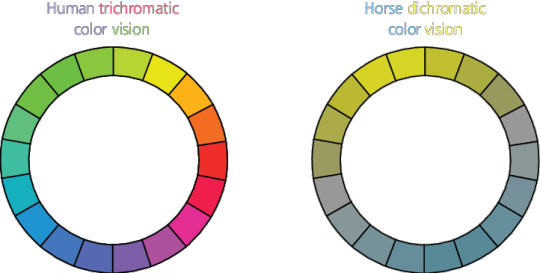
It turns out a lot of animals can’t see the difference between orange and green! Elephants, for instance, have dichromatic vision (two types of cones, rather than three like most humans.)
Check out this diagram from ResearchGate. It deals with the color vision of horses, who are also generally dichromatic. (I think, though I’m not sure, that zebras would have the same color vision as horses.) See how orange and green look to them?
Not to critique evolution but I think prey animals should be better at telling when their predator is dressed like a traffic cone.
It doesn’t matter what zebras see, because tigers are not native to Africa and do not naturally hunt zebra. Tigers are Asian and mostly hunt animals like deer, elk, and buffalo. These aren’t animals with great color vision. They don’t need to have it because they don’t eat fruit and so don’t need to know when the berry is ripe vs when it’s not. Good color vision is too expensive to have if you don’t need it. Deer put their vision stats in a wide field of vision that is sensitive to motion, low light capabilities, and possibly seeing UV light. They don’t have great color and lack a lot of acuity, but have a great sense of smell and good hearing. That’s way more useful if you’re prey. Deer see well in the blue end of the color spectrum and less well in the red. This makes sense because deer are most active in the dawn and dusk periods, when there is more blue in the light. Tigers are taking advantage of deer eyesight by being orange.
We see tigers are being obviously colored because tigers are fruit colored to our tree ape brains.
I don’t know what the best part of this is: implying that deer chose their attributes on a character sheet, or the fact that we get to see tiger colors because they look like a snack.
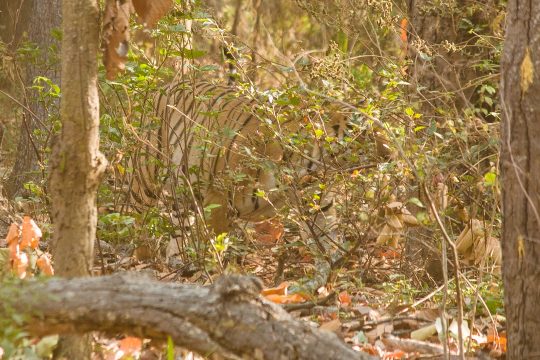
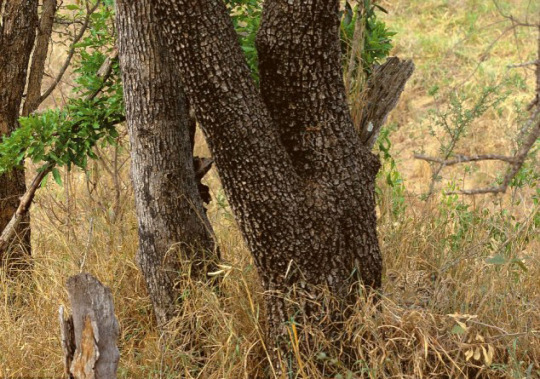
Ok but like, I think you underestimate just how well they blend in when actually in the environment. Like, just using tigers as an example.
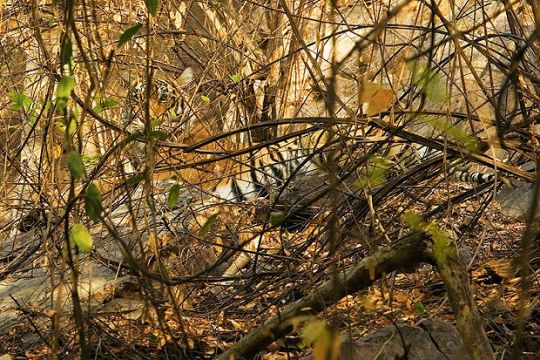
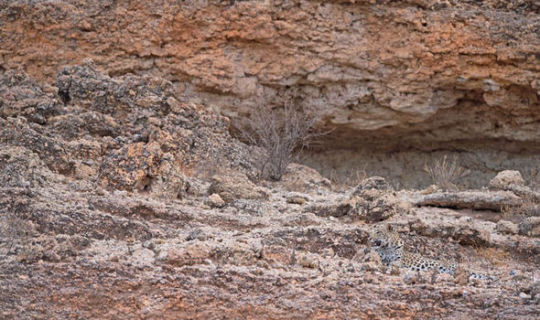
or how about a leopard?
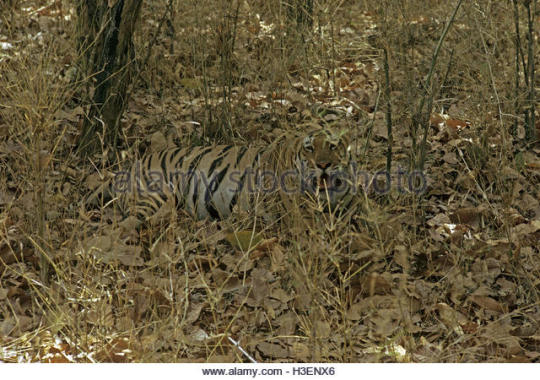
It’s called ‘disruptive colouration’ because the markings help to break up the animal’s outline against the grasses or rocks. And the rosettes on leopards and jaguars? Sun spots shining through the trees and leaves on the ground.
And this is how hard it is to spot them WITH colour vision. Now imagine the above images but with the limited coloured mentioned above?
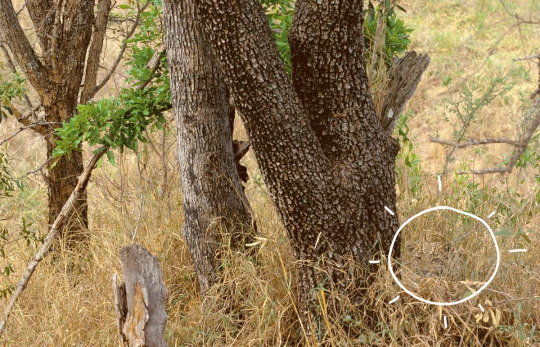
I’m sorry but there is not an animal in that first leopard picture
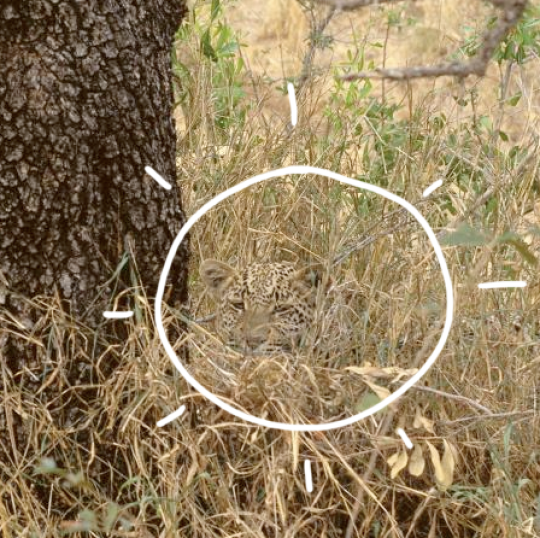
Are you, sure about that?
“Tigers are fruit colored” is my new favorite phrase.
someone is gonna be dinner.
I’d be dead. Took like a minute to see that first leopard. Mind you, seeing the leopard doesn’t stop it. It’s not tag or shit.
Oh, you’d be surprised.
The thing about ambush predators is that they really don’t like being spotted. So much of their success depends on total surprise – getting that completely free attack from behind – that they will frequently break off the stalk entirely if they think they’ve been spotted.
It makes sense. A prey animal that isn’t taken by surprise is a prey animal that has a pretty good chance of escaping, or worse yet, fighting back. Predators don’t want to fight with their prey. The fact that they’ll probably win the fight is irrelevant – a single well-placed kick could break a bone, and the predator is out of commission until it heals. A predator that can’t hunt is a dead predator. Even a more minor injury will still slow them down, which is almost as bad.
There’s one anecdote I recall of a man-eating lion that was troubling a village, and a professional lion scholar (idk what his profession was) managed to discourage it and drive it away simply by keeping surveillance on it, and looking/pointing/making noise every time it tried to line up a strike. Eventually the lion decided “Well fuck, these guys have got me pegged for sure, I can’t possibly get the drop on them” and went elsewhere. There are other stories of big cat attacks being deterred by something as simple as a face-mask on the back of the head, tricking the cat into believing the person is looking at them.
If you spot the leopard first, it will probably slink off in another direction, pretending all the while that’s what it was doing all along. But you’d better keep a sharp eye out, because it’ll be back as soon as it thinks you aren’t looking.

 valar apologist